Not a sophisticated attack. Not a nation state. One file that clears your portal, one person who opens it, and one meeting where somebody asks who was supposed to be checking. EzProtect reads every file and every link before storage. Nothing moves until it is proven safe.
A checkbox is not a security layer. Enterprise security reads every file and every link.
Close to a thousand Salesforce customers lost data recently.
Attackers went after the connections around Salesforce rather than Salesforce itself. One compromised integration reached more than 700 organizations. A second reached more than 200.
Salesforce was never breached. Its customers were. You own everything that enters your org — including files and links from people who don’t work for you.
Not stopping one of these is not an abstract risk.
$6M
Average cost of an AI-enabled breach
$4.99M
Global average breach cost
1,000+
Salesforce customer organizations breached in roughly a year
The U.S. average was $11.5 million for a breach, more than double the global figure. Remember that a single breach means months of investigation, regulatory notification, and legal exposure — before you count revenue lost.
Source: IBM Cost of a Data Breach Report 2026.
We uploaded a real trojan. Salesforce let it through.
EzProtect caught it and blocked it before it was stored. Watch the test, then run it in your own org.
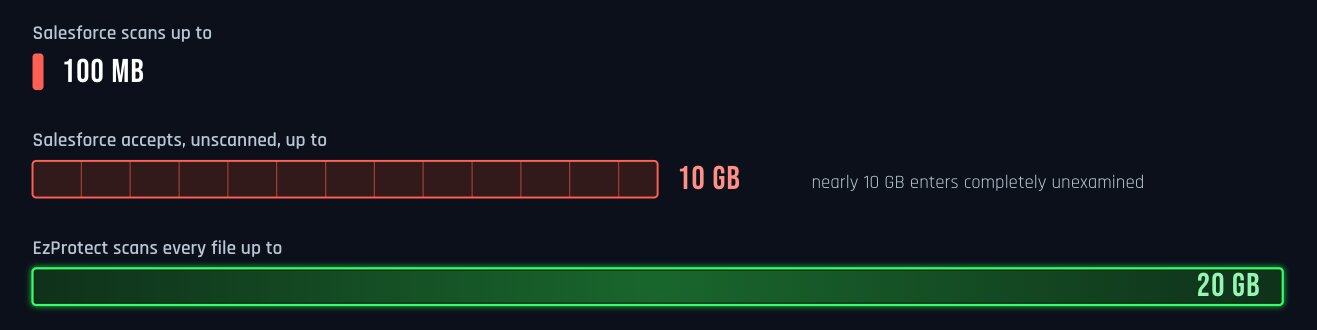
Native scanning misses disguised files, ignores links, accepts API uploads unscanned, and stops at 100 MB. EzProtect covers all of it — signature, behavioral, and true file type detection up to 20 GB, with link scanning across every field and object. Nothing moves until it is proven safe.
Here is exactly where native scanning stops.
Native scanning is a checkbox. EzProtect is a security layer. Every claim in the middle column comes from Salesforce documentation.
Sources: Salesforce Help, Malware Scanning for Salesforce Files, and the Salesforce Lightning Component Library.
Capability
Salesforce native, Summer '26
EzProtect
Detection method
Salesforce native, Summer '26
Not disclosed, flags only files with a high probability of being malicious
EzProtect
Signature, behavioral, and true file type, all testable
Disguised files (.exe renamed to .png)
Salesforce native, Summer '26
File-type controls rely on extension and MIME type, both can be alterered
EzProtect
Reads actual file content with true file type detection
Zero-day and unknown threats
Salesforce native, Summer '26
High-probability cases only
EzProtect
Behavioral analysis in an isolated sandbox
Malicious URLs and links
Salesforce native, Summer '26
Not scanned at all
EzProtect
Scanned across fields and objects against live threat intel
File size scanned
Salesforce native, Summer '26
100 MB or smaller. Accepts 10 GB files unscanned.
EzProtect
Every file up to 20 GB
Files already in your org
Salesforce native, Summer '26
Not scanned until someone downloads one, and that first download is allowed to finish
EzProtect
Scanned on demand across your existing library
Trust model
Salesforce native, Summer '26
Blocks interface uploads. Lets API uploads in first.
EzProtect
No file moves until scanning proves it safe. Takes seconds.
The groups hunting Salesforce customers are not hunting Salesforce.
ShinyHunters and Scattered Spider built their reputations on people rather than code. Scattered Spider impersonates employees and IT help desk staff to reset passwords and bypass multifactor authentication, which CISA documents in advisory AA23-320A. Campaigns tied to ShinyHunters abused trusted integrations and Experience Cloud guest access to reach CRM data across retail, education, and manufacturing. Neither group needed a vulnerability in Salesforce.
Identity controls decide who gets in. EzProtect decides what gets in. Once an attacker is impersonating someone you trust, every file and every link they send looks legitimate, because as far as your access controls are concerned it is. Content inspection is the one control that does not care who the sender is.
Native scanning does not close that gap either, and it is free and identical in every Salesforce org. Someone targeting you can run the same scanner you run, confirm a file slips through, and only then aim it at you. The limits are public, so a file built to clear them clears them everywhere.
One infected file makes you the meeting agenda.
Someone in accounts payable opens it because it arrived on a case from a real customer. By that afternoon, you’re explaining how a stranger uploaded an executable into your org — and the honest answer is your tool was never built to stop it. More than three quarters of security leaders now fear personal liability for an incident, up from about half last year.
The decision you did not make becomes the decision everybody remembers.
EzProtect reads everything before it lands.
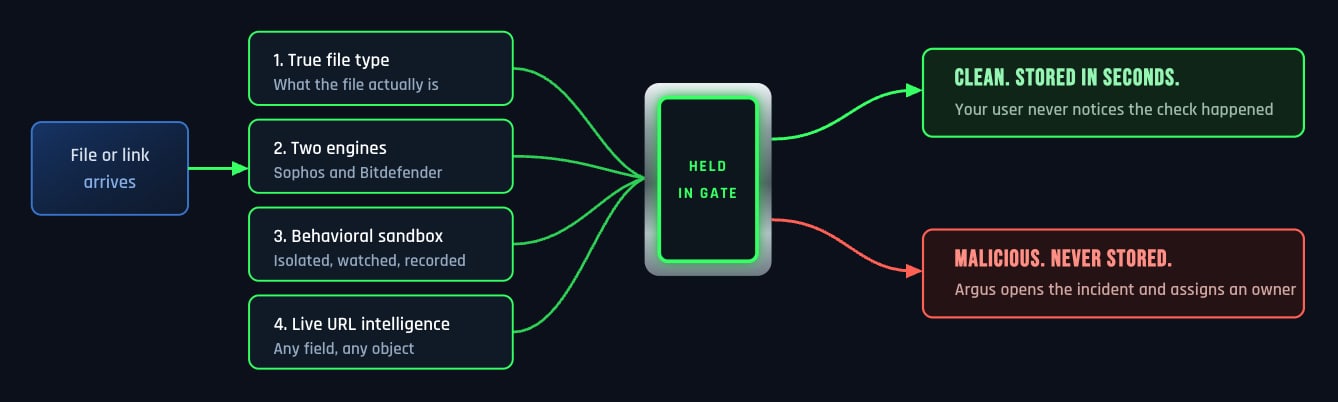
Four checks run on every file and every link entering your orgs. The verdict returns in seconds and nothing is stored until it comes back clean.
We identify what a file actually is
An executable renamed to .png clears extension and MIME controls everywhere else. EzProtect reads the contents and identifies the file for what it is.
We scan links the same way we scan files
EzProtect checks URLs across any field or object against live threat intelligence, then rewrites them so the check runs again the moment someone clicks.
We make unknown files prove themselves
Anything without a known signature runs in an isolated sandbox and gets watched. That is how a threat with no signature yet is stopped before storage.
We cover every way in
Experience Cloud portals, Email to Case, connected channels, and the API. Every file up to 20 GB, with Sophos and Bitdefender behind every verdict.
Your users will never know we are here.
Will this break anything?
It will not. EzProtect installs as a managed package. Scanning happens before storage and returns in seconds, so your Experience Cloud forms behave the way they did yesterday.
How much of this becomes my job?
Very little. Scan activity and blocked threats report into native Salesforce dashboards. Alerts route to the people who should get them. When a real response is needed, Argus assigns it and keeps the record.
Every path into your orgs runs through the same gate. Nothing is stored until the verdict comes back clean.
"We do not take chances on any file a customer uploads for a claim, or any link that arrives in a teammate's inbox. Peace of mind comes with EzProtect and the coverage they keep adding."
— VP of Engineering, Healthcare Provider
Argus takes over the moment something is found.
EzProtect detects the threat. Argus owns what happens next. Every incident gets a named human owner, a phase that will not advance until someone produces evidence, and an escalation clock that keeps running whether or not anyone answers. When the question is who knew and what they did about it, you have an audit ready record instead of a chat thread.