Share
Over the past year, the attacks that hit Salesforce customers had something in common. Very few of them needed a flaw in the platform. They came through connected apps nobody revoked, integration users with far more access than their jobs required and logging that was never switched on. The platform held, while the way organizations configured and connected it did not.
That gap is widening as AI agents arrive. In a survey of 297 cybersecurity leaders, Gartner found that more than half of organizations have no real plan for limiting what AI agents can reach. The ring below shows how big that gap is.
The agent access gap
Most organizations have no plan for limiting what AI agents can reach
of organizations have no defined approach to limiting AI agent access, or simply rely on predefined human access.
In other words, many agents inherit whatever a human user already had, which is exactly the mistake the panel warned against.
Source: Gartner, Sept 30, 2026. Survey of 297 cybersecurity leaders, second quarter of 2026.
Salesforce has also stopped waiting for customers to catch up. It now expires refresh tokens left idle for 30 days and is retiring older OAuth flows on a fixed schedule, as our Winter ’27 enforcements guide explains.
So how secure is Salesforce, really, and how much of the risk sits with customers? That question shaped The State of Salesforce Security, a panel at Security Dreamin’ 2026, the free, virtual community conference for Salesforce architects, admins and security leaders. The event was supported by EzProtect, with Shirtforce as community partner. At the end of the panel, each expert gave Salesforce security a letter grade. Here are the people who did the grading.
This blog starts with their grades, then explains each one: why the platform scores well, why customer configuration and integrations pull the grade down, why good habits break and what AI agents mean for the next report card. It ends with a checklist to raise your own org’s grade.
The grades: a strong platform and a weaker ecosystem
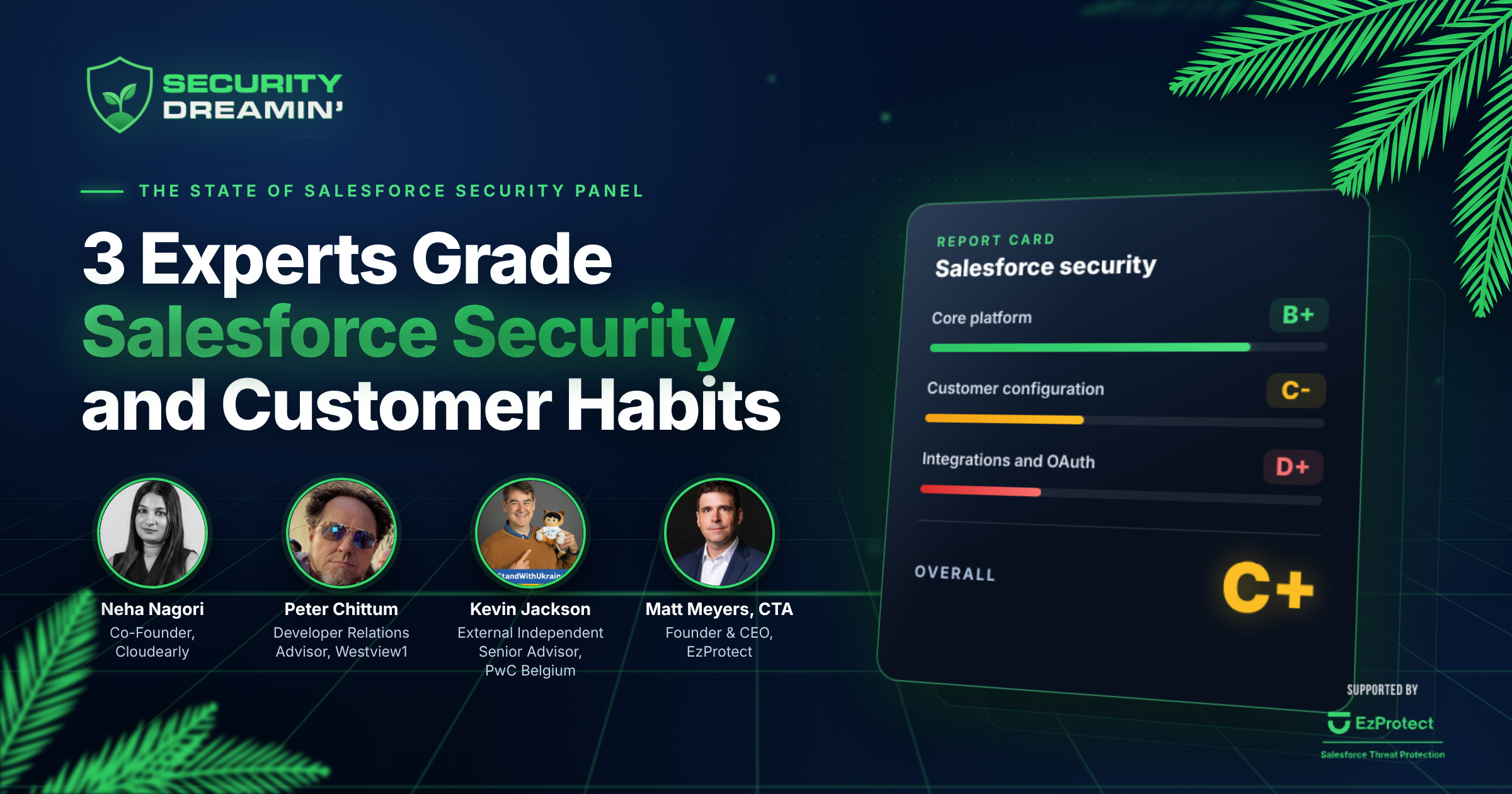
Kevin came prepared with the most detailed answer. He asked a PwC research agent to grade the ecosystem by category, and the report card below shows how far the score falls once you move from the platform to the parts customers control.
The Salesforce security report card
The platform scores well, and the grade drops where customers take over
Core platform and security direction
Customer configuration and identity
Third-party integrations and OAuth governance
Overall ecosystem
Peter ChittumSecurity now gets keynotes and faster releases, with room to improve.
Neha NagoriEvery org earns its own grade, and nobody earns an A.
Category grades come from Kevin Jackson’s PwC research agent. Bars use a standard 4.0 grade scale.
When Matt asked why the overall grade wasn’t a B, the answer was simple: attacks keep succeeding on the customer’s side of the control layer.
Peter gave Salesforce a B. He has watched security grow from a couple of technical sessions at Salesforce events into keynotes, roadmap sessions and a faster stream of features, and he warned that nobody should ever grade themselves too high. Neha refused to give a single grade, because every org earns its own based on its maturity, its integrations and its use of agents. She would put most orgs between B and C, and she would not give anyone an A.
The three grades point the same way: the platform scores well, and the score drops in the parts customers control.
The Security Dreamin’ community is grateful to Neha, Peter, Kevin and Matt for an honest, funny and practical hour. Watch the full panel here.
Why the platform earns a B+
Neha opened the panel by saying the foundation Salesforce has built over more than 20 years works. The incidents of the past year did not break it. They came through how people used it. Peter saw real progress too. He has been exploring Security Center, Salesforce’s paid security add-on, and called it a promising addition, and he is keen on MCP Risk Scores, which Winter ’27 adds to rate third-party MCP servers Low, Medium or High.
Salesforce has also become far more aggressive about safe defaults, and Peter explained why. When he joined Salesforce around 2010, the company had only just stopped letting orgs run without TLS. Today the threat looks very different.
“Once you know how to break into Salesforce, you know how to break into probably hundreds of Salesforce orgs.”
Peter Chittum, Developer Relations Advisor, Westview1
That speed has a cost. Neha described a customer who enabled passkeys while moving staff to cloud PCs, and users were locked out because their passkeys were tied to their old laptops. Her fix for any enforced setting is a short training video for users, because turning a control on is easy and helping people through it is the hard part.
The platform keeps its B+ by moving fast, and it would earn an A if those changes broke fewer orgs along the way.
Why customer configuration drops to a C-
Salesforce’s own Trust pillar draws the line clearly: Salesforce secures the platform, and customers secure their configuration, access controls, custom code and data governance. Neha’s opening example shows what happens on the customer’s side of that line. An org turns on MFA and feels safe, while the gaps shown below sit quietly behind it.
What “MFA is on” can hide
One control is switched on, and three gaps stay open behind it
Scenario described by Neha Nagori at Security Dreamin’ 2026.
When Matt asked which native controls she would insist on in a new org, Neha named four. The first is minimal profiles, with access granted through permission sets and permission set groups and no Modify All or View All Data without written consent from the business. The second is a dedicated, least-privilege integration user for every integration. The third is a Health Check baseline, which every org can run in Setup, reviewed on a schedule. The fourth is Event Monitoring. Core events such as logins are included, but the full set requires a Shield or Event Monitoring license. She knows that cost is the first objection, and her answer is that nobody can investigate what was never logged.
The controls behind a better grade are rarely new, and they are often the ones still switched off.
Why integrations and OAuth governance score a D+
Integrations earned the lowest grade because that is where last year’s incidents came in. Neha pointed out that many of them traced back to connected apps that had never been formally approved, tied to integration users with far more access than they needed. Nobody noticed for years.
Cleaning that up is harder than it sounds. Matt has watched teams recommend switching off connected apps nobody recognized, only for executives to block it over the possible impact on users. Kevin’s advice was to monitor integrations continuously and to know how to back out of any one of them before something goes wrong. Salesforce is also forcing the issue, and the timeline below shows the deadlines every integration owner should know.
Salesforce OAuth deadlines
Older integration methods are being retired on a fixed schedule
Source: Vantage Point, summarizing Salesforce’s Winter ’27 release notes.
For a step-by-step review of the apps already in your org, see our Klue breach checklist. Every integration needs an owner, a minimal scope and a way out, or it will keep dragging the grade down.
Why good security habits break down
Peter’s answer to why good tools get switched off focused on pressure, not apathy. When a team turns a security feature back off, the push usually comes from users, so he would ask whether the rollout was well architected and tested under real conditions. Individuals usually want to do the right thing, he said, but misaligned incentives can push them the other way.
Kevin described the money side. On large implementations, security used to make up roughly 7 to 15% of proposals, and that share is creeping up, yet it is still among the first items cut when budgets tighten. A response plan may sit on paper somewhere, and his question is whether anyone can execute it when an incident hits. Matt has seen organizations take eight months to a year to roll out a tool they already know they need.
Neha changes the conversation with executives. She doesn’t talk about tools. She talks about the questions leaders will face after an incident: how fast they knew, how quickly they fixed it and how it was logged. On ownership, Kevin first joked that it belongs to “the one over there,” then named the CISO, working with the CIO. What gets measured gets focus, he added, although zero breaches is a nice metric until the day it isn’t.
“We scare because we care.”
Matt Meyers, CTA, Founder and CEO, EzProtect
Customer habits improve when someone senior owns security and the team builds it into every project from the start.
AI agents will decide the next report card
When Matt asked whether architects are ready to design access for agents, Neha was refreshingly honest: nobody is ready, including her. For 20 years teams designed for people who work eight hours a day, and now they design for agents that run around the clock. She treats every agent as another user and follows Salesforce’s Agentic Trust guidance, which tells architects to give each agent’s running user only the minimum permissions its job requires. She also named a mistake she has seen firsthand.
“Do not copy the permissions of a real human into an agent.”
Neha Nagori, Co-Founder and CTA, Cloudearly
Her rule is to start an agent as an assistant with minimal access and expand slowly before it runs on its own. Kevin learned the same lesson with Ariel. He was sure she had no access to his email, where his MFA links arrive, and later found she had reached it anyway.
“I would not trust an agent. I would never underestimate them.”
Kevin Jackson, Senior Advisor for Technology, PwC Belgium
Peter doubted that a red team agent can replace real red teaming, which relies on social engineering as much as technology, and then called his own answer a waffle. Kevin, who lives in Belgium, approved of the waffle. With Agentforce renamed AIforce within weeks, Matt’s advice was to plan around what ships and let new features mature before trusting them in production.
Orgs that give agents the same scrutiny as a new employee will be the ones that keep their grade.
How to raise your org’s grade
The panel’s advice turns into a short list. Teams that want a better grade next year can start here.
- Grade your org on platform settings, configuration and identity, and integrations.
- Rebuild access around minimal profiles, permission sets and permission set groups.
- Give every integration its own least-privilege user, and remove unapproved connected apps.
- Run Health Check in Setup against a baseline, and review it on a schedule.
- Confirm which events you log today, and secure full Event Monitoring before you need it.
- Move integrations off retiring OAuth flows before February 20, 2027.
- Give every agent its own minimal permissions, never a human’s.
- Pair every enforced security change with short user training.
- Name the CISO as the executive owner of Salesforce security.
Salesforce earned its grade, and your habits earn yours
The experts agreed on more than their letters suggest. Salesforce has built a strong platform and is enforcing safer defaults faster than ever. The grade falls in the places only customers can fix: the app nobody revoked, the integration user nobody scoped, the log nobody turned on and the agent handed a human’s access.
Each expert left the audience with one thought. Neha said security is not a switch you flip or a product you buy once, and it only works as a habit. Kevin urged everyone to use agents with optimism and never trust them blindly. Peter needed only four words: security is never done.
The platform’s grade belongs to Salesforce. Your org’s grade belongs to your team, and it is set every day by the habits you keep.
Watch every Security Dreamin’ 2026 session
This panel is one of more than a dozen Security Dreamin’ 2026 sessions now streaming, from the keynote to talks on zero trust, canaries and AI agents. Share them with your Salesforce teams.
Share
Did you love this blog and wish there could be more?
It is our goal to keep you informed about everything you need to know about Salesforce security to keep your Salesforce data and company safe and secure by providing you with the highest quality of original content.
If this sounds good to you, then sign-up below to be one of the first to know when the next super awesome Salesforce security blog has been released.